Showing posts with label First Aid and Safety. Show all posts

Saturday, October 15, 2011

Honey & Sugar Great For Your First Aid Kit


For many years people have used honey and sugar to treat wounds. Both are great items to add to your cabinet, if you don't already have them. You might even put a small plastic bottle of honey, in your first aid kit for hunting.

Honey and Sugar have many benefits for treating wounds.
  1. Applying a generous amount of sugar or honey can keep the injured cells from dying and actually aid in regenerating new cells.
  2. Honey or Sugar applied to a wound can draw out inflammation. 
  3. And last, they both can fight against infection. They are both very clean and act as an antibacterial.  Bacteria do not like sugar or honey and will avoid it. 
Sugar and Honey will work the same, but because honey is so thick, it covers the wound a little better. After applied, wound should be covered or wrapped. Using sugar or honey is a great way to treat a wound until you can reach a hospital or doctor. And the best thing is, it works for humans and animals.

Monday, February 14, 2011

Bloat, What It Is And Why You Need To Know About it


X-ray from the underside of a dog with intestinal GDV. The dark area is the build up of gas.
Bloat is a terrible condition that effects, mostly, heavy chested dogs and some working dogs. It happens when the stomach becomes overly extended by too much gas. If the stomach actually twists, it is then called GDV,  gastric dilatation-volvulus  , like in the X-Ray above. The stomach can twist 360 degrees clockwise and about 90 degrees counter clockwise. This twist, prevents gas from escaping and the dog can not belch or vomit.  It can be painful and fatal if not treated right away. Surgery is usually required. Even then the mortality rates are 15% - 33%.
Wikipedia describes it better as: "The stomach twists around the longitudinal axis of the digestive tract".

X-ray of a dog with bloat. Note the classic "double bubble" pattern indicating that the stomach torsion has occurred in this case.

The 5 most susceptible breeds are Great Danes, Weimaraners, St. Bernards, Gordon Setters, and Irish Setters. Standard Poodles, Rottweilers, and Doberman Pinschers are also at risk.  Basset Hounds have the greatest risk for dogs under 50 lbs.

Causes are many, but the one thing they all seem to have in common is a dysfunction  of the sphincter between the esophagus and stomach and an obstruction of outflow through the pylorus, or a clog.  
Other contributing factors include increased age, being one of the breeds mentioned above, having a deep and narrow chest, stress, over eating food that expands in the stomach like kibbles, drinking too much water in a short period of time, and dogs that already have inflammatory bowel disease. Feeding a dog only once a day or feeding them particles smaller than 30mm can increase the risk of bloat. Also if foods that have added oils can also increase the risks.


I am happy to say, we've never had a Gordon that suffered this condition.
Symptoms would include: distension of the abdomen, obvious pain, weakness, depression, difficulty breathing, hyper-salivation and retching without vomiting.


X-ray from the side of a dog with intestinal GDV

Treatment
Bloat is a terrible condition for a dog to suffer. The key is to know your dog and recognize when something is wrong. 
With surgery, in a timely manner, your dog can completely recover and having the surgery usually can prevent another episode.
If you ever suspect your dog is suffering from bloat, get them to the Vet immediately.  

Waiting is not an option if you want to save your canine buddy. And I'm sure you do.


 All info obtained from Wikipedia.

Saturday, January 29, 2011

Mushers Secret - No Secret Anymore!

Back in December I did a post about dogs getting snow and ice build up between their toes and how this can be painful for your pet.
Click here to see the original post: Possible Solution/Last Post/Snowballs Between Toes.

In that post, I suggested a product called, Mushers Secret. I never got the opportunity to try this product but one of my Followers,  ArtOC, has.

Art lives in Maryland where they get their fair share of snow and ice. They also use salt on the roads there and this can irritate a dogs pads with regular exposure.
Art tried Mushers Secret on his Gordon Setter, Erin. Her long furry feathering would get tons of snowballs when she played out in the snow, one of her favorite pass times, according to Art.
Art sent me the picture below. As you can see for yourself,  NO SNOWBALLS on her feet!


Miss ERIN


From ArtOC:

"We finally got a decent snowfall and Erin was just as excited as she could be to go out bird bowling and generally having a good time in the snow.  Just like a kid, she would stay out until she was so cold she was shaking.  I saw your plug for the Mushers and had been tying to buy if for some time but it was always out of stock.  I just received it before the storm and treated Erin's feet.  As you can see from the attached photo, she is covered with snow balls but her feet are not affected.  I also noticed that when we went for a walk the salt didn't sting her feet like it usually does.  This stuff really works!"


Don't you love it when you find a good product?! If you'd like to try Mushers Secret click on the ad to the right for a link to Amazon. This is one of the best prices I've found.

Thanks Art and Erin for sharing your experience with this product. I am always happy to show case a good product with a reliable review.

If you have a great product that you'd like to share with the rest of us dog owners,  please feel free to comment with your suggestion.

~~~~~~~~~~~~~~~~~~~~~~~~~~~~~~~~~~~~~~~~~~~~~~~~~~~~~~~~~~~~~~

Thursday, January 13, 2011

A Warm Bed For A Cold Night

Do you live in an area where the temperature drops below freezing often and especially at night?


Do you leave your dog in an outside kennel over night?
If so, here is a short list of things you can do to help insure that your dog is keeping dry, and warm enough to stay out for an extended period safely.
  1. Make sure your dogs have a decent house to sleep in. It should not be big, or overly tall. It should be just big enough for your dog to stand up in, turn around in, and lay in comfortably. Being just enough room for your dog, will allow his body heat to become trapped inside, and will help to keep him warmer.
  2. It should be insulated.  Even some of the plastic ones have insulation.
  3. The house should be placed in a barn or outdoor building protecting it from the wind, rain, snow, etc., preferably with a eastern/southern exposure.
  4. The house should be placed on a platform which will keep it off the damp ground.
  5. Clean straw or hay should be used for bedding. It dries quickly and is soft for them to sleep on. Cloth bedding gets wet and stays wet, when outside in cold temps. It will get wet, then moldy and that's unhealthy for your dog.
  6. If you can put a flap on the door to prevent drafts, that's a huge help.
  7. And last, if you have really cold, sub-zero weather, you can buy heated pads that can be used outside, but not in the wet weather. 
Our old barn is our kennel. Inside the barn is the individual kennel runs,  which have a run leading to outside. There is a door for each that can be locked closed when it snows hard or temp drops. Each kennel has a heating pad for them when it is very cold, like  below 20 degrees. Dan has added countless "flaps" to the doors of the houses only to come out the next day and find them ripped to shreds. Yep, it seems that a Gordon Setter likes a room with a view! When it drops below about 10 degrees, we bring them up to the house where we have a "puppy whelping" room built off the side of the house. Inside, we can house 4 dogs in a heated room. Of course, as I said this is the "puppy whelping" room that doubles for emergency dog kennels.  We also have 2 kennels inside the house for 2 more dogs. Up here in Montana, it can drop to 20 or 30 degrees below zero in a day and that's dangerous weather for your dogs. With 5 dogs we have to be ready.

Make sure your dog has the protection he needs to stay warm and safe through these frosty cold nights of winter.

Tuesday, January 4, 2011

Snow Between The Toes - Simple Solution

This is not our dog. We would never let one of ours get this bad. This pic came from Google and is just being used to make a point.
A while back I did a post on snowballs between the toes of our dogs feet, called : Snowballs Between The Toes. One dog in particular in our kennel, Gracie, tends to get snowballs between her toes. I've done a lot of research on this and this is what I have found.


The predominant reason, and the most simple one, is that the hair between the toes gets too long and collects snow. The more snow the toes collect, the wider the toes spread. The wider the toes spread, the more snow packs in between.  This isn't good for several reasons.

First, it's not comfortable for your dog. Imagine having snow and ice between your toes!
Second, as it builds up, it forces the toes to spread as the dog walks. Long toe nails are also a problem. This can damage your dogs feet and cause them to walk on the backs perpetuating the problem.
Third, having long hair on the bottom of the feet makes it more difficult to get good traction. This could led to any number of muscular or joint injuries.

So what can you do about it? Well, the biggest thing is to keep the hair between the toes and on the bottoms of their feet cut very short.  If you live somewhere where the temperatures are extreme in the winter, you can apply oils and products like Mushers Secret to help keep the snow from sticking and building up into a giant snowball. These can also keep the dogs pads from drying out and cracking open.

I haven't tried the Mushers Secret. After eliminating the problem by cutting, and keeping the hair short, I really had no need for it.

When you're out hunting this time of year, remember your dogs needs, and look out for them too!

Sunday, December 12, 2010

A Reminder of Christmas Dangers


Only 13 Chewing  Days Left Until Christmas!

Last year I did a post at Christmastime pointing out some of the dangers that can seriously harm or even kill your dog. If you haven't see that post I hope you'll take a look. And if you did read it last year, it's a good reminder.


You can never be too safe when it comes to the health and safety of your dog.

Christmastime Dangers For Gordon Setters

Friday, December 10, 2010

Possible Solution/Last Post/Snowballs Between Toes

This isn't a Gordon. I am using this picture for demonstration purposes only.

This dog has more snow balls on her chest than between her toes, but you get the picture.
Apparently this is a problem for a lot of dogs who either can't or won't wear booties. The snow builds up in the fur between their toes, freezes, and then rubs their toes raw. Booties work well, if you can keep them on. Losing them is a big problem, especially if your are hunting in snow deeper than a few inches.

I did a little research and came across this product called "Mushers Secret".  Mushers Secret was developed for the mushers in Alaska. It is safe and non toxic and made from 100% natural waxes.

Product Description: The only alternative to boots! No more burning from salt, chemicals, sand, sand burn, and hot pavement! No more sore cracked paws! 100% natural waxes do not stain. Apply a thin coat on pads and between toes. Use weekly or as needed. It also claims the wax won't stain.  (we'll see!)

Grouse season is pretty much over for us here in Montana, but I am going to order this and give it a test run. If you're still hunting and you'd like to try Mushers Secret, I have added it to our products list. Just scroll down and look for it in the right column and click on the link provided.  If you do try this product,  please let us know how it works for you and your dog in the areas you hunt. I will post a review as soon as we have a chance to get the product and try it.

Tuesday, December 7, 2010

Snowballs Between The Toes

I got a call from Justin  a few nights ago. Justin lives in  Colorado with his 9 mo. old Gordon,  Benelli. They hunt Blue Grouse on some of the highest ridges in the Rockie Mts. Up in the Stratosphere. Oxygen required. Benelli has a problem with ice and snow build up on his paws. It interferes with  hunting and can cause raw spots between the toes.

Booties are the obvious solution, but in snow the dog often leaves with 4 boots and returns with a lesser  number. My nylon dog boots have a slick bottom and would not do well on ice. I have heard of people using Vaseline or Pam non stick spray on the dogs feet [ especially between the toes] to prevent ice sticking, but have never tried it.  I always carry three dogs and rotate them. When dog #1 gets all balled up with snow, it goes into a crate to thaw out and #2 dog hits the ground. By the time dog #3 has hunted , dog #1 is ready to roll again.

Does anyone have a trick or advice for Justin to that would solve this problem?

Posted By: DWT

Friday, April 30, 2010

How To Remove a Tick

Do you have ticks in your area? Most people do and if you have dogs, you know your dog is going to pick one up eventually. Luckily for us, we don't see many ticks in our area. There is a short period in the spring when we may see one or two, then nothing for the rest of the year. Also, the last time we saw them around, I picked it up and I knew exactly where I had gotten it. So, I bought some stuff that  you spread around in the bushes. This kills the eggs that the ticks lay, before they can hatch out the next year. I'm sorry to say, I don't remember the name, but it was very effective.


To Remove a Tick:

Do Not Use Your Fingers! 
Use a pair of tweezers, or something similar, that will gently grip the head of the tick, then slowly pull it straight out. 
Do Not jerk or twist.
Do not apply anything like alcohol or a hot match to try to make the tick back out. This does not work and in fact, may cause the tick to release even more bacteria into the bloodstream of it's victim.

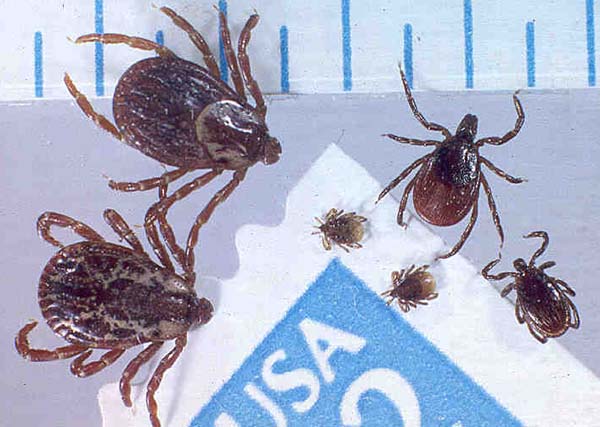
After removing the tick put it in a jar with a little alcohol and this will kill it. Have a container ready when you remove the tick so as to not drop it. Some ticks are very tiny and would be nearly impossible to find in carpet. Just look at the ones in the picture, on a postage stamp!
As a precaution, it's a good idea to apply a triple antibiotic cream to the area of the bite. A small bump will remain at the bite site for several weeks and may even leave a scar. Ticks carry bacteria and serious diseases like lime disease. Should the site become swollen, or infected see your doctor right away.

Especially in the spring, after working outside, it's a good idea to check your entire body for ticks. Give your dog a good going over and remove any ticks you find.

Information Source Drs. Foster and Smith:
http://www.drsfostersmith.com/pic/article.cfm?d=155&articleid=62

Friday, April 16, 2010

Teach Your Children Well....About Your Dogs

As much as we sometimes think of our dogs as humans, they are not. They are domesticated, but are still animals with animal instincts. The instinct to protect their food, their territory, and their health and well being in general. They act and behave, relate and respond, like animals. By instinct.
Teach your children how to respect dogs. Teach them that dogs are animals, they do have feelings, and they can be hurt, just like the child.

Here are a few common sense rules to teach children of any age how to safely, responsibly and lovingly interact with your dog. Hopefully you will have a lifetime of happiness with no misunderstandings from the dog or children, and no one getting bit.

When approaching a dog make a fist,  hold it out upside down and let the dog sniff you. (with adult supervision only) and for children 5 or 6 years and up.

Do not approach the dog when he is eating or at his food bowl.

Do not approach the dog if he is eating or chewing a treat, or his toys. And never try to take a toy from a dog.

Never wake a sleeping dog. Dogs can wake up groggy or grouchy. They can "react" and bite. NO MATTER WHO IT IS. (Let sleeping dogs lie)

Do not hang over a dog or put your arms around their neck. This can be perceived by the dog, as a dominant stance. He may bite, as a way of rejecting the dominance.

Never pull a dogs tail, ears, or any part of the dogs body. And be very careful not to step on the dogs. Again, this can cause a reactionary bite. 

And last, but probably most important, we recommend you never leave any child under the age of 8 or 9 alone with the dog. I realize that seems like a pretty old age, but you'd be surprised what children under that age, do no know. (You'd be surprised at what some adults don't know!)

Sunday, January 24, 2010

Official AKC Recommendations For Pet Preparedness List

According to the AKC, this is a list of items you should have packed together in a "Pet Preparedness Kit" for your pet, in case of emergency.

  1. Leash and collar with ID tags attached
  2.  Medical health records including a current vaccination record and
    rabies tag.....especially the rabies tag.
  3. Photocopy of AKC® registration papers
  4. Recent photo of your pet
  5. At least a three-day supply of food, medication and water
  6. Food and water dishes
  7. Blankets or bedding 
  8. Crate
  9. Favorite toys 
  10. Plastic “pick-up” bags   


    AKC also recommends that you have your dog implanted with a micro chip, or have him tattooed. If that's not possible, at least have a reliable collar with an I.D. tag securely attached.  Losing your beloved pets, can only add even more heartache to an already terrible situation. Be Prepared.

Friday, January 1, 2010

First Case of H1N1 in Dogs


 H1N1 Virus

According to DoggedHealth.com, the first case of H1N1 has been identified in a dog. A mixed breed dog, who is 13 and lives just north of New York, was taken to the vet on Dec. 13 because he was having trouble breathing. Because of this symptom, and because the owner had previously suffered from H1N1, the vet decided to test the dog for H1N1. The dog tested positive for the H1N1 virus, also known as the Swine Flu.  Although this is the first known case in dogs, cats and ferrets have been known to get the H1N1 virus.

There is no evidence that the virus can move from a dog, to a human, but it may not be impossible. If your dog or you, become ill with the H1N1, it is wise to take the same precautions with your pets as you do with your other family members. Wash your hands constantly, no lip to lip kissing, sneeze or cough into a tissue or your elbow. 

Symptoms of H1N1 in your dog may be: coughing, runny nose, fever, lethargy, reduced appetite, and/or breathing difficulties. These are pretty much the human symptoms as well.


Source: Doggedhealth.com

Tuesday, December 22, 2009

How To Safely Move Your Injured Dog

An injured pet can be unpredictable. When they suffer pain, they react instinctively. Even though you may be trying to help, you could get bit.

If you have to move an injured dog, you may consider making a muzzle to prevent your dog from biting out of fear or pain. Any strong material will do. Tear it in strips about 2" wide. Using the middle of the strip, wrap around your dogs muzzle. Bring the ends under his chin and tie snugly around the back of this head, just under his ears.  Be sure not to cover or seal off his nose. This will make it safer for you to handle your pet.

You can move him on a blanket, holding the sides securely, to a vehicle to transport. If you can, cover your dog to keep him warm. Covering can also sometimes help calm a frightened animal.

As soon as you have your dog stabilized,  call your vet and let him know you are on the way. This gives them the opportunity to prepare for his arrival. And do this BEFORE you are driving down the interstate at 75 mph! :+)

Taking these simple steps can prevent further injury to your dog and prevent any injury to you as well.

Thursday, December 17, 2009

Christmas Dangers for Gordon Setters

The Christmas season is a wonderful time of year, but it can be dangerous for our pets. Dogs are naturally curious and there are plenty of bright shinny objects to draw their attention. Glass balls, metal ornaments, shinny tinsel, and the little metal hooks are all very dangerous if chewed, eaten, or swallowed. Ribbon and tinsel can cause intestinal blockage. A serious problem that often requires surgery. There's the lights of course, and the electric cord that dogs sometimes like to chew.  These should be hidden from site, or at a level your dog can not reach.

Your Christmas tree itself, is a danger as well. Cedar, Fir, Juniper, Pine, and Balsam, can cause irritation to your dogs mouth and stomach if he eats or chews these. Trees that are purchased commercially, have been treated with  preservatives that can irritate the mouth and stomach, as well as the sap itself. And don't forget the water that sits below your tree, it can be contaminated also. I always tie my tree to something to stabilize it. I have small grandchildren, as well as a Gordon or two running around the house.

Most holiday plants are toxic also.  Poinsettia, mistletoe, hemlock, and holly are all toxic. They can cause vomiting and diarrhea and increased salivation. Dogs can become lethargic and have no appetite. Ingesting hemlock will cause nervousness, trembling, reduced heart rate and potentially paralysis or death.  Keep all of these in a spot where your dog can't get to them.

Snow Globes, not likely to be eaten, but if they are small, your dog might mistake them for a doggie ball. Apparently these are often made with ethylene glycol, the same ingredient in antifreeze. And we know antifreeze is deadly to animals. Not to mention the glass cutting their mouth, gums, and  intestines.

If you have kids in the house, be careful when opening gifts that you don't leave small batteries  or toy parts laying around to temp your dog. They WILL chew it. They are DOGS!

Be safe this holiday season and spend a little extra time to pick up and put up, to keep your furry four legged friend happy and healthy. They rely on us to keep them safe.

Sunday, November 15, 2009

Keep Your Micro Chip Information Current

Micro Chips are a great invention that allows us to keep track of our black and tans. If your dog gets lost, hopefully, he will end up in a place that has a scanner and will detect his micro chip. Then, the owner is called and owner and pet are reunited. Trouble is, 80% have outdated information and about 40% aren't even registered. Keep your info updated when you move, or get a new phone number, be sure to update the info with your register service. It could mean the difference between life and death for your pet.

Friday, November 13, 2009

Xylitol Sweetener Toxic to Dogs


More and more vets are seeing dogs come into their office with Xylitol poisoning.  Xylitol,  is a sugar alcohol used as a sweetener in a lot of sugarless candy, gum, soft drinks,  Tic Tacs and even toothpaste.  It's perfectly harmless to us humans but can cause seizures and even death in our Gordon  Setters.  Xylitol can cause an insulin release, which can cause liver failure. Increased insulin leads to hypoglycemia. Elevated liver enzymes and liver failure can be seen with in just a few days.

Initial symptoms are vomiting, lethargy and loss of coordination. Seizures can come on as quick as just a few minutes after ingestion.  Death can come as quick as 30 minutes depending on how much the dog eats.


Sources:  ASPCA, Snopes.com, MSNBC.COM

Wednesday, November 11, 2009

How To Remove Porcupine Quills From Your Bird Dog - Follow -Up

This is a follow-up to the previous blog about Maynard and Emma and a porcupine!

This is what Maynard found out, on how to remove porcupine quills, if you need to yourself and can not get to a vet.

Cut the end of the quill to release the air inside. Grab the quill as close to the skin as possible and then pull. Sounds painful to me!! 


Keeping a small sturdy pair of needle nose pliers or surgical forceps with your dog equipment would probably be a good idea if you live in an area that hosts porcupines.
Maynard's vet, however, did give him some Rimadyl to tranquilize her in case this happens again. Fortunately, we have practically no porcupines in our area, or we would have the tranquilizers!

Tuesday, November 10, 2009

Emma VS. Porcupine

 A friend of ours who has a Gordon Setter from our kennel, sent me this picture of "Emma" who recently had a dangerous encounter with a porcupine, while hunting south of Spokane, Washington.

Maynard sent me the following in an email:


 Emma VS. Porcupine

We were hunting a long finger of very tall grass in the middle of a wheat field when all of a sudden, Emma went on point. We couldn't see the bird so I told Donny to start kicking up the grass in front of her. Nothing came up, so Donny said,"Emma, get it up"! She moved in, and next thing you know, she's lying on her side, pawing her face. Donny moved forward to help her and almost stepped on a porcupine. She's 7 years old and this was our first porcupine, so I didn't know what to do.

Emma not only had quills in her mouth but also at least 3 in one  of her eyelids. She squirmed around in the tall grass until she was able to get her mouth closed, then I had to go in and drag her out of the tall grass and into the field where I could look at her. Initially, it looked so bad, I thought I'd lost my dog, or at best, I'd end up with a one - eyed huntin' dog. She got lucky that none ended up in her paws so she could still walk. We were about 2 miles from the truck and I never would have been able to carry her out. It could have gone really bad.
Talk about a dog with heart, she hunted her way back to the truck!  LOL  The vet said I should have named her Lucky, she got to keep her eye,
Now I have to do some research on the net as to removing quills from a dog*, so I'm better prepared if there is a next time.


*NOTE: HOW TO REMOVE QUILLS - NEXT BLOG
 

Sunday, November 8, 2009

Think Twice About Rawhide Chews

Rawhide products are not regulated or inspected by the Food &  Drug Administration. That means we do not know FOR SURE what is in or on these treats. Many rawhide treats are made in other countries that have even fewer regulations than us. Tests have shown that a lot of rawhide carries salmonella bacteria and ever worse, arsenic. Sometimes harsh chemicals like bleach and lye, are used to clean the hair and tissue from the hide. They may leave a residue behind.

Rawhide can swell up and get stuck in the stomach, intestines, or esophagus. Believe it or not, your dog can not digest rawhide. If it irritates the gastrointestinal tract it may cause diarrhea and vomiting.

It's better to give your dog clean, safe, and digestible treats. Wash your hands with soap after handling.

Salmonella Found in Pigs Ear & Beef Hooves, Packaged for Dogs

The FDA issued a warning this week about the possibility of Salmonella in pigs ears and hooves that were packaged for dog treats and sold all around the country. The pig ear products were sold under the brand names Doggie Delight and Pet Carousel.  The beef hooves carried the names Choo Hooves, Dentley's, Doggie Delight and Pet Carousel. All sizes and all lots are included.

For further details, go to DoggedHealth.com, or click on the blog title above.

In case you're wondering....YES Salmonella can make your dog very sick.